

- Definitions
- Compassion
- Health
- Environment
- Vegan Food Pyramid
Environment
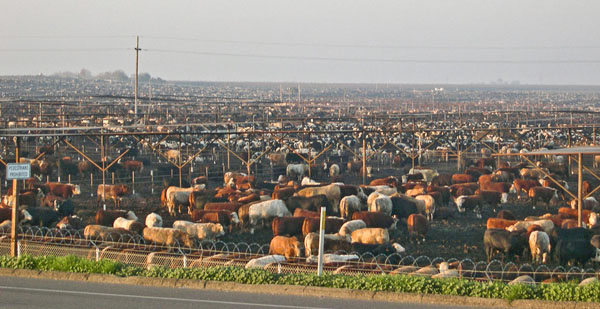
Feedlot in California
The animal industry isn't only rough on animals, but also on our environment.
 The livestock sector is a major stressor on many ecosystems and on the planet as a whole. Globally it is one of the largest sources of greenhouse gases and one of the leading causal factors in the loss of biodiversity, while in developed and emerging countries it is perhaps the leading source of water pollution.
-- the Food and Agriculture Organization of the United Nations.
The global demand for animal products like meat, dairy and eggs is currently still increasing. In 2012, around 301 million tonnes of meat were produced worldwide.(1) To be able to meet de demand for these products, more animals are bred and more grain is grown to be able to feed them. These animals also produce a lot of waste, which causes water and air pollution.
Water
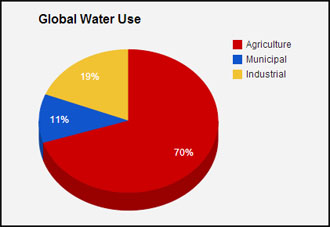
Of all the water on our planet, only 2.5 percent is freshwater. 70% of that freshwater is used in the agriculture sector.(1)
It has been estimated that 29% of the total water footprint of the agricultural sector in the world is related to the production of animal products.(3) Most of this water is used to irrigate the land on which food is grown to feed livestock.
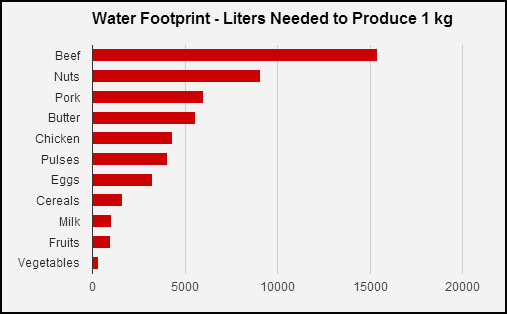
The following graph shows you the water footprint of several products from animal and vegetable origin.
Pollution
"A kilogram of beef is responsible for more greenhouse gas emissions and other pollution than driving 3 hours while leaving all the lights on back home."
-- Daniele Fanelli, "Meat is murder on the environment". New Scientist, 18 July 2007.
One dairy cow produces approximately 120 pounds of manure each day, which is equal to the waste produced by 20-40 people. Animal waste can contain pollutants like hormones, antibiotics, heavy metals, nitrate and ammonia. Some of these pollutants will end up in our rivers and underground drinking water.
Other pollution caused by the animal industry are air quality problems caused by gases emitted from the decomposition of animal wastes. This includes dust, smog, greenhouse gases and odors and can cause or worsen respiratory illnesses like lung inflammation or asthma.
Deforestation
Animal agriculture accounts for more than 80% of annual world deforestation.(2) Cattle ranching has destroyed more rain forest and caused more loss of biodiversity than any other activity in this part of the world.
Sources
- Statistics obtained from the Food and Agriculture Organization of the United Nations.
- Agriculture is the direct driver for worldwide deforestation. September 25, 2012, Wageningen University and Research Centre.
- The Green, Blue and Grey Water Footprint of Farm Animals and Animal Products by A. Hoekstra, University of Twente, The Netherlands.