

- Bees
- Chickens
- Cows
- Deer
- Donkeys
- Elephants
- Frogs
- Geese
- Horses
- Lobsters
- Pigs
- Rabbits
- Rats
- Seals
- Sheep
- Turkeys
Turkeys
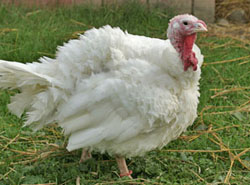
Turkeys are large birds related to pheasants. They lived almost 10 million years ago. Wild turkeys are native to wooded areas of North America. Turkeys are the only breed of poultry native to the Western Hemisphere. They were first domesticated in Mexico and brought to Europe in the 16th century.
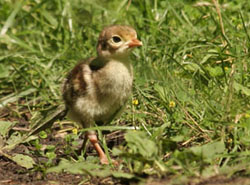
A male turkey is called a tom or a gobbler, a female turkey a hen, and a baby turkey a poult or chick. A young male turkey is called a jake and a young female is called a jenny. A group of wild turkeys is called a flock, a group of domesticated turkeys is commonly referred to as a rafter.
Turkeys are able to adapt to a wide variety of habitats. However, most wild turkeys are found in hardwood forests with grassy areas.
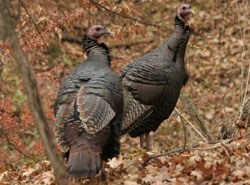
Wild turkeys can fly for short distances at speeds up to 55 miles per hour. On the ground they can reach speeds of 25 miles per hour. Domesticated turkeys usually weigh too much to be able to fly. Their weight is about twice the weight of a wild turkey.
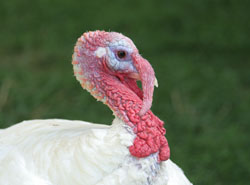
The carancle is a brightly colored growth on the head and upper neck. The snood is the flap of skin that hangs over the turkey's beak. The wattle is the flap of skin under the turkey's chin.
The bare skin on the throat and head can change color from flat gray to shades of red, white and blue when the turkey becomes distressed or excited.
The gizzard is a part of the stomach that contains tiny stones, which helps them grind up food for digestion.
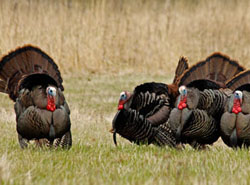
Wild turkeys have dark feathers which help them blend in with their habitats. Domesticated turkeys have been bred to have white feathers.
Male turkeys have black, hairlike feathers on their breast called beards. Some female turkeys have them too.
Turkeys have great hearing , but no external ears. They have a field of vision of about 270 degrees and are able to see in color. They can see movement almost a hundred yards away. They don't see well at night. They have a poor sense of smell, but a good sense of taste.
Wild turkeys often spend their nights in trees on low branches, preferable over water to help protect them from tree-climbing predators. They will fly to the ground at first light.
Male turkeys will start making their gobbling sound before sunrise and continue through most of the morning. Hens make a clicking sound.
Wild turkeys spend most of the day searching for food like seeds, wild berries, small insects and acorns.
The worst predator of the wild turkey is the raccoon. Raccoons will catch and kill young turkeys and also attack a hen's nest and destroy the eggs.
Turkeys are social animals. They enjoy the company of other creatures, including humans. They love having their feathers stroked.
In the spring, male turkeys puff up their bodies, spread their tail feathers, grunt and make their gobbling sound to attract as many females as possible.
After mating, the female turkey prepares a nest under a bush in the woods and lays her eggs. She will lay one egg each day until she has a complete clutch of about 8 to 16 eggs. The eggs are tan and speckled brown eggs. It takes about 28 days for the chicks to hatch. After hatching, the babies will flock with their mother all year. The first two weeks they won't be able to fly and the mother will roost with them on the ground.
Benjamin Franklin wanted to make the wild turkey, not the Bald Eagle, the national bird of the United States.