

- Bees
- Chickens
- Cows
- Deer
- Donkeys
- Elephants
- Frogs
- Geese
- Horses
- Lobsters
- Pigs
- Rabbits
- Rats
- Seals
- Sheep
- Turkeys
Rats
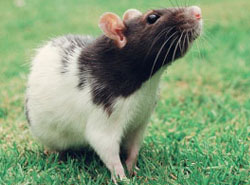
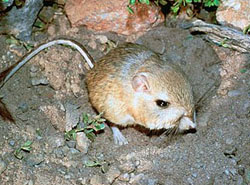
Rats belong to the order of Rodentia. The term "rat" does not describe a group of closely related species, but is a common term for rodents that look alike to the casual eye, regardless of ancestry: short-bodied rodents, usually having a pointed muzzle, long slender tail and dexterous forepaws. Rats include kangaroo rats, Norway rats, cotton rats, pack rats, wood rats, greater stick-nest rats, roof rats, naked mole rats and many others.
The term rat usually refers to the two main species of house rat, the Norway rat and the Roof rat. Both species originated in Asia, but have spread throughout the world by human travel overseas. They both belong to the genus Rattus, which includes 51 species.
Rats average life span is 2 to 3 years. They are nocturnal, have poor eyesight and are colorblind. They primarily see light, shadow and movement. They do have very developed senses of hearing, smell, touch and taste. Their hearing is ultrasonic. Touch is via their long whiskers.
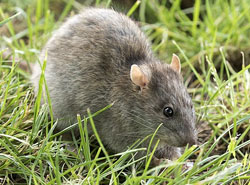
Rats are omnivores. Among other things they eat seeds, fruit, grains, nuts, flowers, leaves, insects, birds, reptiles, fish, eggs and fungus. They consume about 1 ounce of food and drink about 1 ounce of water each day. Their strong teeth are able to gnaw through wood, copper, cinder block, aluminum, and uncured concrete.
Rats are very social and affectionate animals. They love being in the company of their own species or humans. They like playing together and love to sleep curled up together. They take care of the injured and sick rats in their group. When rats don't have companionship, they can become lonely, depressed, anxious and stressed. A group of rats is called a mischief.
Rats use high-frequency sounds, smell, touch and body postures to communicate with each other.
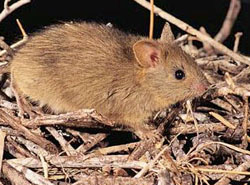
Norway rats belong to the species Rattus norvegicus. Other names for the Norway rat are brown rat, gray rat, common rat, house rat, wharf rat, barn rat, sewer rat and water rat. They prefer temperate zones. They burrow extensively in soil and like to nest in basements and lower portions of buildings. They are poor climbers, but great swimmers.
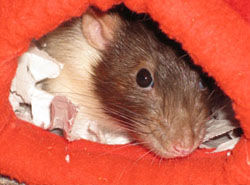
Norway rats have a heavy and thick body about 7 to 10 inches long. They weigh about 10 to 17 ounces. Their color may vary from grayish-brown, a pure gray to a blackish- or reddish-brown. Their underside is gray to yellow-white. Their nose and muzzle are blunt, their eyes are small and their ears are close to the body and won't cover the eyes if bent forward. Their tail is dark on top with a lighter underside and shorter than their head and body.
The White rat is an albino strain of the Norway rat, also known as Pink-Eyed White or PEW.
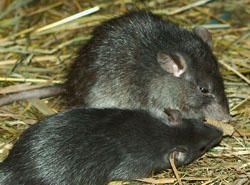
Roof rats belong to the species Rattus rattus. Other names for the Roof rat are Alexandrian rat, black rat, fruit rat and ship rat. They prefer tropical and semitropical zones and can be found on all continents of the earth. They burrow very little and like to nest outside in trees or in upper portions of buildings. They are great climbers, but don't like to swim.
Roof rats have a slender body about 6 1/2 to 8 inches long. They weigh about 6 to 12 ounces. Their color varies from black to brownish-gray. Their underside varies from gray to white. Their nose and muzzle are pointed, their eyes are large and prominent and their ears are large and cover the eyes if bent forward. They have a hairless tail which has a uniform color and is longer than their head and body.
Female rats average 4 to 6 litters each year. Norway rats average 8 to 12 pups per litter, Roof rats 4 to 8 pups. Their gestation period is three weeks and they can become pregnant again within 1 to 2 days after giving birth, while continuing to nurse their current litter of pups. The pups are usually weaned when they are about 3 to 4 weeks old. Pups are born blind and naked. It takes about 7 days for their hair to start growing and 12-14 days for their eyes to open. The pups stay in the nest built by their mother until they are weaned. Often litters of numerous females will share the same nest and are cared for by the all the females, regardless of who their true mothers are. If a mother dies, the other females will take over nursing her pups. Male rats don't participate in the parental care.
Rats have a strong social hierarchy. The biggest and strongest rats will get the best food and harborage.
Rats use their tails to regulate their temperature, to communicate and for balance. They have glands on the bottom of their feet and will lie on their backs to sweat. They have no canine teeth, no thumbs, no gallbladders and no tonsils. They do have bellybuttons.
Rats are intelligent animals. They are more intelligent than rabbits, hamsters, mice, gerbils and guinea pigs for instance. They also have excellent memories. Once rats learn a navigation route, they never forget it.
Rats are very clean animals. They spend several hours each day grooming themselves and each other. They are less likely than dogs or cats to catch and transmit parasites and viruses.
Rats are curious but shy. They prefer to run away rather than confront a potential threat.
Predators of rats are cats, birds, reptiles and other carnivorous animals.