

- Bees
- Chickens
- Cows
- Deer
- Donkeys
- Elephants
- Frogs
- Geese
- Horses
- Lobsters
- Pigs
- Rabbits
- Rats
- Seals
- Sheep
- Turkeys
Rabbits
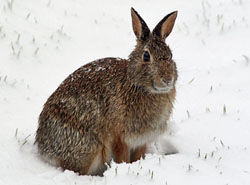
Rabbits are part of the order of Lagamorpha, which comprises of gnawing herbivorous mammals having two pairs of incisors in the upper jaw one behind the other. Belonging to this order are rabbits, hares and pikas.
Rabbits were originally classified with rodents because of their gnawing incisors, and superficially looking and acting like rodents. DNA however, puts lagomorphs closer to ungulates than to rodents. Lagamorpha was seperated from Rodentia in 1912.
There are over 50 established breeds of domestic rabbit, thought to have been first domesticated by the Romans.
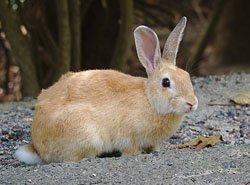
The domestic rabbit or its wild form are found around the world. They have been deliberately and accidentally released in many locations. They were released on islands by seafaring explorers so that there would be food on that island should humans return.
Rabbit bodies are flattened and long with elongated hind legs. Rabbits have long sensitive ears that can be turned in any direction and a short tail. Their eyes are large and placed high on the side of the skull. They have nearly a 360 degree field of view. Their fur is thick, often long and very soft and their feet (unlike rodents) are fully furred. Their nostrils are slits that extend into a cleft in the lip leading to the mouth. They have control over the nostril opening, with muscles in the upper part, and are said to "wink" their noses.
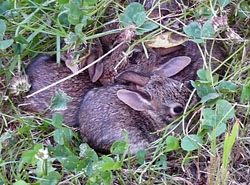
Rabbits live in groups, in underground burrows. They like dry, well-drained slopes on field edges, grassland, woodland and dunes. They live in open country where predators like foxes and birds of prey are easily spotted. One rabbit is always on guard when they are feeding. When danger approaches the guard stamps its feet and the whole colony will bolt down their burrows.
Rabbits eat any vegetation within reach, including grasses, growing trees, tree bark, small herbs and agricultural crops.
Rabbits can have babies at age 6 months old. They can have 20 to 40 babies a year. Litters of 3 to 7 young are produced, at five-week intervals, from January to late summer.
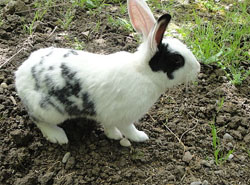
Rabbits weigh from 2 to 11 pounds. In the wild their longevity averages 1 year but captives live about 10 years.
Rabbits are very susceptible to over-heating and often pant. In the wild they go underground to avoid the heat.
Rabbits have to groom their fur frequently otherwise it will become matted and lose its insulating properties. This means that rabbits avoid getting wet.
Rabbits can run 35 miles per hour. They are faster than cats.