

- Bees
- Chickens
- Cows
- Deer
- Donkeys
- Elephants
- Frogs
- Geese
- Horses
- Lobsters
- Pigs
- Rabbits
- Rats
- Seals
- Sheep
- Turkeys
Geese
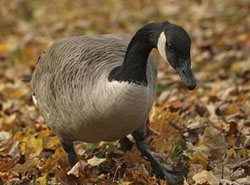
Geese belong to the order Anseriformes, which includes all sorts of waterfowl. Swans and geese are the largest waterfowl, characterized by long necks and non-iridescent coloration. Even though they are waterfowl, geese spend most of their time on land.
There are two major genera among the geese: Anser geese and Branta geese.
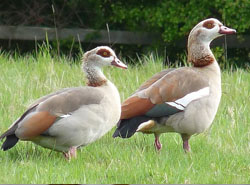
Anser geese usually have pink, orange or gray legs and bills. Their bills are serrated. Belonging to this group are the species Bar-Headed, Bean, Emperor, Greylag, Pink-Footed, Ross', Snow, Swan Goose and White-Fronted.
Branta geese always have black bills, which are softer than those of the anser geese and without serrations. Belonging to this group are the species Barnacle, Brant, Canada, Nene or Hawaiian and Red-Breasted.
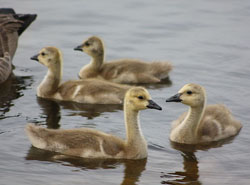
A baby goose is called a gosling. A group geese is called a gaggle.
The life expectancy of geese is about 25 years.
Geese spend most of the day foraging for food, which is primarily obtained by grazing. They like short grasslands next to a body of water and prefer fertilized over unfertilized grass for feeding. This is what attracts them to golf courses, playgrounds and other well-maintained lawns.
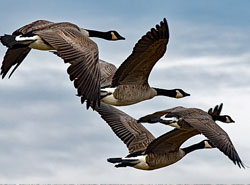
Geese fly in V formation. The flapping of wings of one goose creates an uplift for the goose immediately following. Flying in V formation adds at least 71% greater flying range, than if each goose flew alone. When the goose in front gets tired, another goose will take over the front position. Geese will honk to encourage those up front to keep up their speed.
Geese have strong affections for others in their group. If a goose gets sick or is wounded, a couple of other geese may drop out of formation to help and protect him. They will try to stay with the disabled goose until he dies or is able to fly again. They will then either fly together or join another formation to catch up with their group.
Geese will choose a mate when they are about three years old and will stay monogamous for life, raising new families together each year. If one mate dies, the other mate will sometimes wait several years before choosing a new partner or might even stay single.
Geese have a very strong instinct to return to their general area of birth to mate and nest. They will either return to the exact site or to a nearby pond or other body of water. Migratory geese will even fly 2,000-3,000 miles to return to these sites. Geese like to build their nests on the ground at isolated sites near water.
The female goose will build a nest and line it with down plucked from her body. She will lay one egg each day until the full clutch of about 5 eggs is obtained. After all the eggs are laid, she will sit on her nest to incubate the eggs, which takes about 28-30 days. Whenever she leaves the nest, she will cover the eggs with sticks to keep them warm and to camouflage to nest. During all this, the male goose will stand somewhere nearby to keep watch, but not too close as to give away the location of the nest to a predator.
The parents will lead the goslings to the safety of open water within 24 hours of birth. Goslings are able to dive and swim 30-40 feet underwater when they are just 1 day old. They will eat almost continuously.
Goslings are able to fly when they are about 2-3 months old. They will stay with their parents and follow them back the following year to the place where they were born. There they will form flocks with other young geese. Geese are one of the few birds in which the family does not break up at the end of the breeding season.
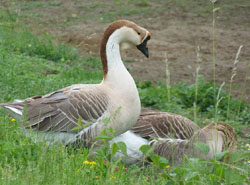
Once a year, adult geese will lose flight and tail feathers, which is called molting. They are unable to fly until the new feathers have come in. This takes about 6 weeks. Geese like to be near water during the molting season, to be able to escape from predators.
The natural predators of geese are foxes, owls, raccoons and snapping turtles. When geese are scared or threatened, they will stretch out their necks and honk loudly. Male geese are very protective of their female partner and will often stand between her and a perceived threat.
Geese use about 10 different sounds to communicate, depending on the situation confronting them.