

- Bees
- Chickens
- Cows
- Deer
- Donkeys
- Elephants
- Frogs
- Geese
- Horses
- Lobsters
- Pigs
- Rabbits
- Rats
- Seals
- Sheep
- Turkeys
Cows
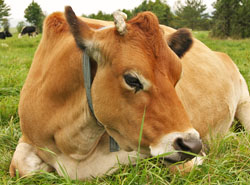
A cow is a mature female and a bull an adult male of a bovine family. A heifer is a female cow that hasn't had a calf yet. Cattle is the name for the whole "cow" family.
There are about 920 different breeds of cows in the world. They were domesticated about 5,000 years ago. Cows came to America with the Pilgrims.
Modern domestic cattle are believed to belong to either the species Bos taurus (like Holstein, Brown Swiss, Jersey and Guemsey), or the species Bos indicus which are humped cattle like the Brahman. Some cattle are a cross between those two species.
The smallest type of cow is a breed called Dexter, which was bred a small size for household living.
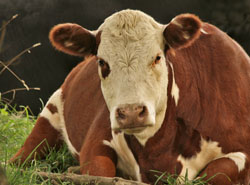
The average lifespan of a cow is 18 to 22 years, but some can live 25 years or even more. You can guess the age of a cow that has horns by counting the number of rings on the horns.
Cows have almost total 360 degree panoramic vision and are able to see colors, except red. They can detect odors up to 5 miles away. Cows can hear lower and higher frequencies better than humans.
Per day, a cows spends 6 hours eating and 8 hours chewing cud. A cow doesn't bite the grass, but she curls her tongue around it. A cow has no upper front teeth.
The average cow drinks about 30 gallons of water and eats about 95 pounds of feed per day.
A cow stands up and sits down about 14 times a day.
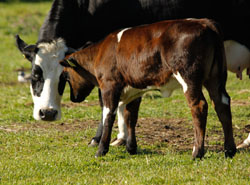
The mean gestation period of a cow is between 279 and 290 days. The bond between a cow and her calf is very strong and continues after the calf is fully grown. In non-commercial herds, some cows will nurse their calves for up to 3 years.
A cow weighs about 1400 pounds. A 1000 pound cow produces an average of 10 tons of manure a year.
Cows are very social animals. They form large herds and will bond to some herd members while avoiding others. They "moo" and use different body positions and facial expressions to communicate with each other.
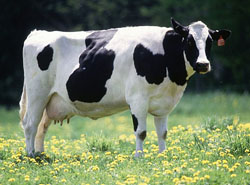
A Holstein's spots are like a fingerprint. No two cows have exactly the same pattern of spots.
A cow has one stomach containing four digestive compartments: the rumen, reticulum, omasum and abomasum. The rumen is the largest compartment and acts as a fermentation chamber. The abomasum is last of the four and is comparable in both structure and function to the human stomach.
Cows have cloven hooves. In galloping through boggy places or in deep mud, cattle can run faster than a horse. Their toes spread, and therefore their wide feet do not sink so deep as do those of the solid-hoofed horse.